




The authors of this article are attorneys that represent clients in the U.S. commercial space industry. Because of the strength of the industry in the United States, we represent many foreign businesses that wish to move their operations to the United States, create subsidiaries in the United States, or at the very least use the services of launch providers and other U.S.-based organizations in the industry. In this article, we will discuss the regulatory ecosystem that these clients face. In particular, it will discuss the following:
- The International Traffic in Arms Regulations (ITAR) and the Export Administration Regulations (EAR);
- The National Oceanic and Atmospheric Administration’s Remote Sensing Regulations;
- The Federal Communications Commission’s Telecommunications Regulations;
- The Federal Aviation Administration’s Launch and Reentry Regulations; and
- The regulations of the Committee on Foreign Investments in the United States (CFIUS).
The ITAR and the EAR
Perhaps the one legal issue that affects space-industry businesses the most is U.S. export controls, particularly the International Traffic in Arms Regulations (ITAR), which are overseen by the Directorate of Defense Trade Controls (DDTC) and the Export Administration Regulations (EAR), which are overseen by the Bureau of Industry and Security (BIS). In the sections below, we will provide a brief introduction to the role U.S. export controls play in the commercial space industry.
What things are controlled?
The ITAR deal exclusively with items that are listed on the U.S. Munitions List (USML).1 The EAR, meanwhile, deal with pretty much everything else that is not on the USML. The EAR govern the export of truly mundane things that aren’t listed anywhere in the regulations (everything from cats to band aids), which we classify as EAR99, and they also govern certain things that are listed in the EAR on the Commerce Control List (CCL),2 such as most spacecraft. As you can imagine, EAR99 items have very few rules that apply to exporting them, while items on the CCL have more rules that apply to exporting them.
What activities are controlled under both the EAR and the ITAR?
The most important activities controlled under both the EAR and the ITAR are exports, reexports, and retransfers. Depending on certain factors, a person might be required to obtain a license from DDTC or BIS before engaging in these activities. We will introduce these concepts below.
Exports – A truncated definition of the term “export,” would be:
- an actual movement or transmission of a thing out of the United States (e.g., shipping a package to France, emailing a PDF to Canada, or allowing a person in a foreign country to access files in your Dropbox); or
- releasing or otherwise transferring controlled information to a foreign person in the United States, which we call a deemed export (e.g, showing a CAD file on your laptop to a foreign person who is sitting next to you in a coffee shop in Dallas).
The actual definition of export is a bit longer and more nuanced than what is written just above, but this definition is a great start for the export controls novice.
As discussed above, releasing or otherwise transferring controlled information to a foreign person while the foreign person is in the United States is a deemed export. This scenario often occurs when a foreign person visits a company’s production facility in the United States, and while at the facility, the foreign person is able to see information controlled by the ITAR or the EAR on computer screens, printed schematics, or whiteboard drawings. The foreign person might also learn the information aurally or be able to visually inspect a piece of hardware beyond what is available to the public.
Given that a deemed export can only occur when a “foreign person” is involved, we must understand what this term means. The following are considered “foreign persons”:
- Any human who is not:
- A U.S. citizen/national
- Green card holder
- Refugee/asylee
- Any business that was not formed in the U.S.
- Any agency or division of a foreign government
Reexports – When an item controlled by the EAR is exported to one country, the U.S. government often continues to govern the item and imposes rules on any further movements to any other countries beyond the first. Each such movement to another country is considered a reexport.
Retransfers – When a person receives a license from the U.S. government to export a thing, the license will allow the export to a particular person (usually a particular company). As with reexports, the U.S. government continues to control the item and will often not allow the item to be retransferred to another person without a new license.
What other activities are controlled under just the ITAR?
In addition to the activities described above (exports, reexports, and retransfers), the ITAR control a few more activities that aren’t controlled by the EAR, including defense services, brokering activities, and temporary imports. We define each below.
A defense service is:
- The furnishing of assistance (including training) to foreign persons in the design, development, engineering, manufacture, production, assembly, testing, repair, maintenance, modification, operation, demilitarization, destruction, processing, or use of items described on the USML;
- The furnishing to foreign persons of any information described on the USML; or
Military training of foreign units and forces, regular and irregular, including formal and informal instruction of foreign persons in the United States or abroad or by correspondence courses, technical, educational, or information publications and media of all kinds, training aid, orientation, training exercise, and military advice.
Brokering activities include any action on behalf of another to facilitate the manufacture, export, permanent import, transfer, reexport, or retransfer of a U.S. or foreign item described on the USML or defense service, regardless of its origin. This definition is quite broad and encompasses a number of activities that normally would not be captured by the commercial use of the term brokering.
A temporary import is simply an import that the importer intends to return to origin at the time of the import. Permanent imports are not regulated by the ITAR (although in some cases they might be regulated by the Bureau of Alcohol, Tobacco, Firearms and Explosives).

National Oceanic and Atmospheric Administration’s Remote Sensing Regulations
The National Oceanic and Atmospheric Administration (NOAA) is responsible for licensing the operation of private remote sensing space systems under the Land Remote Sensing Policy Act of 1992.3 Remote sensing is defined as “… the collection of unenhanced data by an instrument in Earth’s orbit which can be processed into imagery of surface features of the Earth.”4
Many spacecraft have the ability to remotely sense the Earth whether it be intentional or unintentional. For instance, a spacecraft that uses sensors solely to dock with another craft will, while performing positional maneuvering, likely catch a glimpse of the Earth. Due to this capability, NOAA must review the remote sensing capabilities and issue a license to the company for operation of those sensors. Many companies will be told they do not need a license because the imaging capability is lower quality than what is already commercially available. NOAA’s licensing process works by categorizing remote sensing capability into three tiers. Generally, the more competition a company has and the more commercially available the type of data being gathered is, the less need for regulation. Tier 1 is the lowest level of regulation, and Tier 3 is the highest.
To kick off the process with NOAA, an initial contact form is submitted to the NOAA Commercial Remote Sensing Regulatory Affairs (CRSRA) website.5 This form is intended to help the company and NOAA work together to determine if regulation is needed. This process is free, and responses are quick.
If NOAA determines a license is necessary, then a full license submission is required with a great deal of technical information, as required by the regulations.6 CRSRA will consult with the company to complete the application and, once complete, circulate the application to various other agencies to review in an interagency review process. Under the interagency review process, several federal agencies get to weigh in on the risks associated with the remote sensing activity described in the application.7 This process will ultimately influence the restrictions that come back on any license that is granted.
Notably, NOAA is one of the more straightforward, fastest, and simplest agencies a space company operating in the United States will deal with on the journey to a successful Mission 1.
Federal Communications Commission’s Telecommunication Regulations
The FCC is responsible for a great number of regulatory responsibilities. One of them is allocation spectrum usage for communicating with things in space. In short, if a company deals with anything in space or a ground station, it will require a license from the FCC. The licensing process is intended to (a) avoid interference with other objects in space and (b) ensure there is a plan to mitigate the risk of orbital debris.
Communications, whether terrestrial or extraterrestrial, rely on use of the electromagnetic spectrum. You might recall from using walkie-talkies as a child that other devices operating on the same channel can cause interference. This is the same reason that commercial airlines ask you to switch off your cell phone when the pilot is communicating with the airfield tower operator. For this reason, the FCC allocates who may use which frequencies within certain spectral bands within the United States. The FCC also coordinates with the International Telecommunications Union (ITU) to make sure that interference is minimized on a global space.
FCC regulations are complex and very technical. Also, much like export controls, finding the right regulatory path can be as daunting as the path itself. One notable difference in working with the FCC and other federal agencies is that Congress has authorized the FCC to charge fees to cover operational costs of the agency. A full satellite constellation operator can expect to pay an application fee, annual regulatory fees, post a bond, and hire counsel to help them assemble information. Collectively, the cost is often hundreds of thousands of dollars with lots of room for variation depending on the novelty of the company’s mission and how contested the spectral allocation will be.
There are several licensing paths to go down with the FCC. Most space companies will realistically consider Experimental (Part 5),8 Commercial Constellation (Part 25),9 Small-Sat,10 and possibly Earth station licensing.11 Experimental licensing is easily the most affordable, at only a few hundred dollars, but it is not available for missions that have been commercialized. Instead, most major constellation operators have Part 25 licenses, but those are difficult to obtain and cost prohibitive for new market entrants. Acknowledging this problem, the United States created the Small-Satellite Streamlined process within Part 25, which is more affordable and faster if the satellite meets specific requirements. Finally, Earth station licensing is required to authorize ground antennas that will be uplinking and/or downlinking to/from satellites or other spacecraft.
Federal Aviation Administration’s Launch and Reentry Regulations
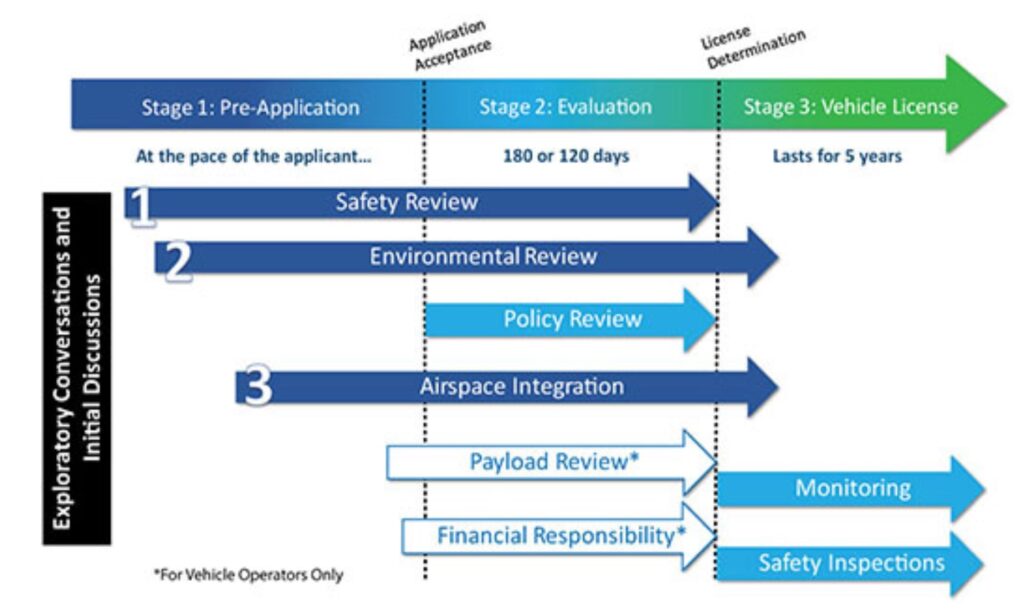
The FAA Office of Commercial Space Transportation (AST) provides authorization for companies to launch and/or reenter Earth’s atmosphere. The FAA reviews applications for safety risks to the public on both launch and reentry, national security interests, and environmental and property hazard.12 The FAA is also directly responsible for compliance with Article IV of the 1975 Convention on Registration of Objects Launched into Outer Space.13 When reviewing the manifest of spacecraft aboard a launch, the FAA, upon authorization, provides that information to the Department of State by reporting to the United Nations.
Just like the FCC, there are many types of authorizations available and/or required from the FAA. License types include: operator licenses, launch licenses, re-entry licenses, spaceport operator licenses, and a few others. There’s no cost associated with the FAA’s portion of the licensing process, but that can change if you need the Environmental Protection Agency (EPA) to provide a report as part of the FAA application process.
Aside from licenses, there are three primary types of approvals: payload reviews, policy reviews, and safety approvals. A payload review is normally performed as part of a launch authorization; however, an applicant may request a payload review in advance of and separately from a launch authorization. This is highly recommended for a novel spacecraft or mission such as orbital transfer vehicles. FAA AST conducts the policy and safety reviews as part of the payload review. They will also assess the payload proposed for launch to determine whether a license applicant or payload owner or operator has obtained all required licenses, authorization, and permits.
Safety approvals can be included within other reviews or stand on their own. Some are mandatory, and some are voluntary. When requesting a safety approval for a new vehicle, safety system, process, service, or personnel to prospective launch and reentry vehicles, a policy review will also be conducted to assess security risks. Other forms of safety reviews, such as a launch site safety review, are mandatory and conducted in the process of a launch license evaluation.
The most complex part of working with the FAA is getting started early enough. To kick off the process, a pre-application consultation is scheduled. License documents will be generated, and other agencies will be brought in. This includes other parts of the FAA and the U.S. Coast Guard to discuss airspace and coastal water safety. Upon the application being submitted and approved by the FAA AST, stage two begins. Stage two contains a policy review, payload review, and assessment of financial responsibility should something go wrong. A final interagency review will occur at this time, and occasionally issues are brought up by other agencies. If everything goes smoothly, a license determination will be made within six months.14
The Committee on Foreign Investments in the United States
The mandate of the Committee on Foreign Investments in the United States (CFIUS) is to review transactions between a U.S. business and a foreign person to determine whether the transaction poses a risk to U.S. national security, and if so, to mitigate that risk.15 CFIUS has the authority to recommend to the president to user powers stipulated under Section 721 of title VII of the Defense Production Act of 195016 to suspend or prohibit a particular transaction.
CFIUS has jurisdiction to review a transaction in one of four scenarios:
- A covered control transaction;
- A covered investment;
- A chance in the rights that a foreign person has with respect to a U.S. business in which the foreign person has an investment, if that chance could result in a covered control transaction or covered investment; or
- Any other transaction, transfer, agreement, or arrangement, the structure of which is designed or intended to evade or circumvent the application of the CFIUS regulations and the underlying statute.17
We will briefly discuss covered control transactions and covered investments below.
Covered Control Transactions
A covered controlled transaction is any transaction by or with any foreign person that could result in foreign “control” of any U.S. business, including such a transaction carried out through a joint venture.18 Control is defined very broadly, and one cannot escape CFIUS jurisdiction by merely asserting that a foreign person has less than a majority equity interest. Rather, control is defined as the power, direct or indirect, to determine, direct, or decide important matters affecting an entity. This may be accomplished through majority ownership or a dominant minority, through board representation, proxy voting, or even information arrangements to act in concert.19
While that definition is very broad, fortunately the CFIUS regulations provide some assistance by listing certain minority shareholder protections that don’t, in themselves, confer control,20 as well as several examples of fact patterns that CFIUS has determined don’t constitute control.21
Covered Investments
The CFIUS regulations define covered investment as an investment, direct or indirect, by a foreign person (other than an excepted investor), in an unaffiliated “TID U.S. business” that:
- Is not a covered control transaction; and
- Affords the foreign person:
- Access to any “Material Nonpublic Technical Information” in the possession of the TID U.S. business;
- Membership or observer rights on, or the right to nominate an individual to a position on, the board of directors or equivalent governing body of the TID U.S. business; or
- Any involvement, other than through voting of shares, in “Substantive Decisionmaking” of the TID U.S. business regarding:
- The use, development, acquisition, safekeeping, or release of sensitive personal data of U.S. citizens maintained or collected by the TID U.S. business;
- The us, development, acquisition, or release of “Critical Technologies”; or
- The management, operation, manufacture, or supply of “Covered Investment Critical Infrastructure.”
As you can see by the quotation marks that we’ve included in this definition, there are several more defined terms within this defined term. Unfortunately, the most difficult part of analyzing the CFIUS regulations is that every important definition includes several layers of nested definitions within it.
Address the first nested definition, “TID U.S. Business” includes, among other things, businesses that manufacture, fabricate, or develop “Critical Technologies.”22 Without fully defining “Critical Technologies,” they include items controlled by the ITAR and items controlled by the EAR for reasons other than anti-terrorism reasons.23 In our experience, nearly every company in the space industry with which we have worked manufactures or develops such “Critical Technologies,” and, as a result, is a “TID U.S. Business.” However, CFIUS jurisdiction can be avoided by eliminating the investor’s access to “Material Nonpublic Technical Information”,24 not granting any rights to oversight of the board, and otherwise eliminating the investor’s right to participate in “Substantive Decisionmaking.”25
Conclusion
Space is hard, and it’s not just the rocket science and astrophysics. There are several federal agencies in the United States that apply complicated and onerous regulations. The cost and time commitment associated with compliance is very high, and the barrier to entry is steep and expensive. The summaries included in this article are brief, and there’s a lot more to them.
Furthermore, this article doesn’t even touch on all the complex worlds of contracting with the Department of Defense, NASA, and other U.S. government agencies. In short, companies looking to enter the U.S. space industry should speak with legal counsel very early in the game, and preferably attorneys who are well-versed in the regulatory environment.
End Notes
- 22 CFR § 121.1. ↩︎
- 15 CFR § 774 Supp 1. ↩︎
- 51 U.S.C. § 60101, et seq. ↩︎
- 15 CFR § 960.4 “Remote sensing”. ↩︎
- https://www.nesdis.noaa.gov/about/our-offices/commercial-remote-sensing-regulatory-affairs. ↩︎
- 15 CFR Part 960, Appendix A. ↩︎
- 15 CFR Part 960, Appendix A. ↩︎
- 47 CFR Part 5. ↩︎
- 47 CFR Part 25. ↩︎
- https://www.fcc.gov/document/streamlining-licensing-procedures-small-satellites-1. ↩︎
- https://www.fcc.gov/earth-station-licensing-sample-form-312-applications. ↩︎
- 14 CFR Part 450. ↩︎
- 14 CFR § 450.217, https://treaties.un.org/doc/Publication/UNTS/Volume%201023/volume-1023-I-15020-English.pdf. ↩︎
- https://www.faa.gov/space/licenses/licensing_process/ ↩︎
- 31 CFR § 800.101. ↩︎
- Id.; 50 U.S.C. § 4565. ↩︎
- 31 CFR § 800.213. ↩︎
- 31 CFR § 800.210. ↩︎
- 31 CFR § 800.208. ↩︎
- 31 CFR § 800.208(c). ↩︎
- 31 CFR § 800.208(e). ↩︎
- 31 CFR § 800.248. ↩︎
- 31 CFR § 800.215. ↩︎
- 31 CFR § 800.232. ↩︎
- 31 CFR § 800.245. ↩︎